OPINA NEWS 2405 · 29 OCT 2026 · Publication identity
Publication identity
Publication identity and editorial standards
Opina News 24 · ISSN 3127-8310
Opina News 24 · ISSN 3127-8310
International digital edition · Issue 5
Editorial team: OPINA NEWS 24. Each article identifies its authorship and sources. Provisional figures must retain that qualification and the date consulted. Photographs retain captions, credits and licences.
Translations are reviewed before editorial sign-off. Research-based features are not presented as original interviews or eyewitness reports. Corrections must remain traceable.
OPINA NEWS 2405 · 29 OCT 2026 · Egypt: museums and pharaohs
Egypt: museums and pharaohs
Egypt opens the gates of eternity: a new home for the pharaohs’ treasures
The Grand Egyptian Museum in Giza brings together Tutankhamun’s treasures in the shadow of the pyramids. A journey through its architecture, galleries and the science protecting the past, with one essential clarification: the mummies of Ramesses II and other rulers are in another museum, in Cairo.
Entrance to the Grand Egyptian Museum in Giza, photographed on 20 December 2025. Documentary photograph; reproduced unchanged.Amr F.Nagy / Wikimedia Commons · CC BY-SA 4.0 · https://creativecommons.org/licenses/by-sa/4.0/ · https://commons.wikimedia.org/wiki/File:Grand_Egyptian_Museum_2025_(77418).jpg
GIZA · CULTURE AND HERITAGE Documentary feature · Information checked on 28 October 2026
The first image is a statement of intent: a vast façade of triangular geometries, an open forecourt and visitors approaching a building designed to accommodate an immense history. In Giza, beside the landscape of the pyramids, the Grand Egyptian Museum changes the way one of the world’s most recognisable civilisations is presented. Its objects cease to be merely icons reproduced in books and on screens: they become part of a narrative about people, power, beliefs and memory once again.
The institution, known internationally by its English initials GEM, held its inauguration on 1 November 2025 and opened fully to the public on the 4th. These dates matter: partial openings and trial visits came first. Reports from those stages, announcing galleries that remained closed, do not necessarily describe the experience available in October 2026. [1, 2]
The museum presents itself as the world’s largest devoted to a single civilisation. Its most celebrated attraction is Tutankhamun’s funerary collection, but reducing it to the gleam of a mask would mean remaining on the surface. Its approach demands a change of scale: from monumental statue to delicate textile, from contemporary building to ancient tomb, from the memory of a king to the expertise of those who conserved his possessions. [2, 3]
WHERE THE PHARAOHS REALLY ARE
A frequent confusion should be cleared up before the visit begins. The Grand Egyptian Museum in Giza and the National Museum of Egyptian Civilization, NMEC, in Fustat, Cairo, are different institutions. Both offer an encounter with the pharaohs’ world, but they do not hold the same collections or tell the same story.
The GEM houses Tutankhamun’s funerary treasures and great representations of rulers, including the colossal statue of Ramesses II that welcomes visitors. The presence of that sculpture does not mean his mummy is there. To see the royal mummies, the destination is the NMEC: its dedicated hall holds the remains of ancient kings and queens, among them Hatshepsut, Thutmose III and Ramesses II. [2, 4, 5]
The ceremonial transfer on 3 April 2021 brought 22 royal mummies from the Egyptian Museum in Tahrir to the NMEC. That figure describes the transfer; it should not automatically be confused with the number displayed at any given time. The NMEC hall’s own webpage currently describes 20 mummies, 18 kings and two queens, while other institutional pages retain the figure of 22 for the transferred group. This feature preserves the distinction rather than turning two different references into a false certainty. [4, 5]
The question “where are the pharaohs?” therefore has several answers. A ruler may be represented by his statue in Giza, by objects from his reign in another collection, and by his remains in a different place. Separating body, burial goods, monument and image helps explain archaeology and prevents visits being planned around mistaken expectations.
OPINA NEWS 2405 · 29 OCT 2026 · Egypt: museums and pharaohs
Egypt: museums and pharaohs
Statue of Ramesses II in the GEM’s Grand Hall, photographed on 31 August 2026. Reproduced unchanged.NileReference / Wikimedia Commons · CC BY-SA 4.0 · https://creativecommons.org/licenses/by-sa/4.0/ · https://commons.wikimedia.org/wiki/File:Statue_of_Ramesses_II_inside_the_Grand_Egyptian_Museum_EG.jpg
A BUILDING IN CONVERSATION WITH THE PYRAMIDS
The architectural project is by heneghan peng. Its designers describe a building articulated through visual axes related to the pyramids and adapted to the change in level between the Nile Valley and the desert plateau. Architecture makes the setting part of the narrative: the pyramids become the external reference for what is explained inside. [6]
In that sequence, the Grand Staircase plays a decisive role. It organises the ascent towards the galleries and culminates in views of the monumental landscape. Visitors move through spaces of different dimensions before encountering the collections. In an institution so extensive, finding one’s bearings is also part of the cultural experience.
The editorial reading proposed by this route is straightforward: looking at an object in a display case and then at the plateau helps connect object and territory. The museum offers explanations; the landscape recalls that those objects belonged to a world built, inhabited and transformed over generations.
The building also required international collaboration among architects, engineers and builders. BESIX, which delivered the project with Orascom Construction, highlights the challenges of a geometry dominated by triangles and the integration of facilities designed to protect antiquities. Behind the façade lies an infrastructure for conservation, security and everyday operation. [7]
RAMESSES II: THE SCALE OF POWER
The statue of Ramesses II turns the entrance hall into an introduction to the language of monarchy. Its size imposes a physical relationship with the viewer: seeing it means lifting one’s gaze. The engineering of its relocation became part of the museum’s modern history. An article written by Arup professionals dates its placement in the entrance space to 2018 and describes a sculpture around eleven metres high and weighing 83 tonnes. [8]
Monumentality can be read as a form of political communication. The figure of a ruler projects permanence; stone embodies an authority that seeks to outlive the person represented. From a contemporary perspective, the statue raises questions about how public images are constructed and why some names survive better than others.
It is a powerful introduction, although the visit gains depth when fascination with size is briefly set aside. History also appears in fragments, inscriptions and less spectacular objects. Observing them calls for another rhythm, slower and more attentive.
TUTANKHAMUN, BEYOND THE MASK
The galleries dedicated to Tutankhamun form the GEM’s best-known centrepiece. Exhibition-design documentation describes approximately 7,500 square metres and a route that approaches both the king’s life and the discovery of his burial. The aim is to bring the collection together and restore relationships among objects that an isolated photograph cannot explain. [3, 9]
OPINA NEWS 2405 · 29 OCT 2026 · Egypt: museums and pharaohs
Egypt: museums and pharaohs
Tutankhamun’s funerary mask. Archive photograph taken on 1 January 2016 at the Egyptian Museum in Tahrir; it does not show its current display at the GEM.Roland Unger / Wikimedia Commons · CC BY-SA 3.0 · https://creativecommons.org/licenses/by-sa/3.0/ · Recorte previo de Firebrace (2019); sin modificaciones adicionales · https://commons.wikimedia.org/wiki/File:CairoEgMuseumTaaMaskMostlyPhotographed.jpg
The famous mask attracts attention, but time should also be reserved for furniture, clothing, chariots and everyday possessions. The funerary assemblage provides information about a courtly environment as well as expressing religious beliefs. An object can be beautiful and, at the same time, a source for understanding techniques, uses and ways of representing authority.
Tomb KV62 was discovered in 1922 by Howard Carter and his team in the Valley of the Kings. According to the Ministry of Tourism and Antiquities’ description, it is a relatively small burial with approximately five thousand objects packed tightly inside. They included clothes, jewellery, cosmetics, furniture, toys, chariots and weapons. The collection made a king whose reign was brief famous throughout the world. [10]
That exceptional survival also shapes our perspective. The figure best known to the public need not be the ruler of greatest political importance. Fame also depends on what survives, how it is discovered and how it is communicated. Tutankhamun makes it possible to explain the difference between ancient history and the modern history of archaeology.
Large totals for the burial goods vary between sources and inventory criteria. It is therefore more prudent to speak of thousands of objects than to present a number as universal and immutable. What matters to visitors is that the museum enables the collection to be seen in a much broader context than that of its most famous pieces.
GOLD AS THE LANGUAGE OF ETERNITY
The funerary mask can be read as an image of transformation. Its original purpose belonged to the religious and funerary world; seeing it only as exceptional jewellery diminishes its meaning. An art-history explanation published by Smarthistory connects its headdress, beard and protective figures with the ruler’s divine representation and passage into the afterlife. [11]
Today, the gleam offers an immediate visual attraction, but the more fruitful question is what that image was meant to achieve for those who made it and placed it with the deceased. The museum allows admiration to become interpretation: observe materials, shapes and signs, then seek the explanation linking them.
Burial goods must also be distinguished from the body. Presenting the treasures together in Giza does not justify claiming that Tutankhamun’s mummy has been transferred to the GEM. Getty Conservation Institute documentation on the tomb locates it in KV62; subsequently, the large outer coffin was transferred and conserved, according to the Egyptian ministry. Body, coffins and other funerary elements have different conservation histories. [12, 13]
TWELVE GALLERIES TO CHANGE PERSPECTIVE
The museum has twelve main galleries whose approach combines a historical sequence with three broad themes: kingship, society and beliefs. The ministry’s announcement of their trial opening described a journey from prehistory to the Roman period. That breadth invites another simplification to be avoided: imagining ancient Egypt as one uniform period. [14]
OPINA NEWS 2405 · 29 OCT 2026 · Egypt: museums and pharaohs
Egypt: museums and pharaohs
Stelae and sculptures in the Grand Egyptian Museum galleries, 20 December 2025. Documentary photograph; reproduced unchanged.Amr F.Nagy / Wikimedia Commons · CC BY-SA 4.0 · https://creativecommons.org/licenses/by-sa/4.0/ · https://commons.wikimedia.org/wiki/File:Grand_Egyptian_Museum_2025_(15133).jpg
To make the most of it, questions can be asked throughout the visit. What does a royal image say about power? What can an object reveal about the people who used it? How do beliefs shape the representation of the body and death? This method turns a succession of galleries into a personal investigation.
It also helps identify the limits of evidence. A surviving object is a trace of the past, not a complete reproduction of a society. Its material, provenance and context matter as much as its beauty. Panels and explanations should accompany observation; where a detail is unknown, it is better to keep the question open.
The visit can thus alternate between two scales. One follows the museum’s overall narrative. The other pauses before a single work to examine its surface, condition and function. A few minutes with one object often provide a richer experience than racing to photograph every landmark.
KHUFU’S BOAT: ANOTHER DOOR INTO THE ANCIENT WORLD
The official ticketing channel includes Khufu’s Boats Museum among the spaces covered by the visit. This naval heritage broadens the route beyond sculptures and precious-metal objects. Institutional information on the opening highlights the solar boat transferred from beside the Great Pyramid to a facility equipped for its conservation. [1, 2]
Looking at an ancient vessel encourages reflection on technical knowledge, material selection and collective labour. It is a way of remembering that pharaonic civilisation produced more than images of kings: it also developed practical solutions and forms of expertise that could acquire ritual meanings.
Its conservation introduces a very contemporary question. How can a fragile object be shown to large numbers of people without compromising its future? The answer depends on decisions visitors may not notice at first glance and which must accompany any ambition to exhibit.
THE INVISIBLE MUSEUM: THE SCIENCE BEHIND THE VISIT
An essential part of the GEM operates outside the usual visitor route. Its conservation centre reports eight specialised laboratories. The institution also describes a joint project with Japanese cooperation focused on the transport, study and conservation of 72 objects made of wood, textiles and mural painting. They included funerary beds, chariots and fabrics associated with Tutankhamun. [15, 16]
This work introduces another set of protagonists. The public experience depends on conservators, researchers, technicians and staff who document and care for the collections. A completed display case is the visible result of a long chain of decisions about materials, supports and presentation conditions.
JICA explains that its collaboration has included specialist training, conservation and construction. In April 2025, a new project was agreed to strengthen the GEM’s capacity as a centre of conservation and research in the Middle East and North Africa. Its institutional ambition therefore goes beyond welcoming visitors: it includes producing and transmitting knowledge. [17, 18]
OPINA NEWS 2405 · 29 OCT 2026 · Egypt: museums and pharaohs
Egypt: museums and pharaohs
From an editorial perspective, this work deserves as much attention as the major attractions. A museum demonstrates its value when it can explain what it knows about its collections, how it protects them and which questions remain unanswered. Heritage is not preserved by admiration alone; it needs skills, continuity and resources.
FUSTAT: AN ENCOUNTER WITH THE ROYAL MUMMIES
At the NMEC, the experience changes tone. The Royal Mummies Hall was conceived to evoke the Valley of the Kings. Its presentation connects the ancient rulers with funerary practices and with the knowledge enabling human remains to be studied without reducing them to a visual curiosity. [4, 19]
Here, the difference between statue and person becomes particularly intense. A royal representation communicates an idealised image; preserved remains recall a body that once lived. Approaching them calls for respect and awareness that scientific knowledge and public interest coexist with questions about the dignity of the dead.
For those travelling with the specific intention of “seeing the pharaohs”, the NMEC is an essential reference. The GEM offers objects and the broad narrative of civilisation; Fustat provides an encounter with the mummies of several of its rulers. The institutions complement one another and each deserves its own time.
TAHRIR REMAINS PART OF THE STORY
The Egyptian Museum in Tahrir Square should not disappear from the cultural map either. Inaugurated in 1902, it remains an institution distinct from the GEM. The ministry highlights the Narmer Palette and the treasures of Tanis among its collections. Redistributing objects between museums does not mean that a building’s entire memory has been transferred elsewhere. [20]
For readers, this map prevents confusion: Giza for the GEM; Fustat for the NMEC and its royal mummies; Tahrir for the historic museum. Three places, three routes and the same need to consult current information before travelling.
HOW TO PLAN A MEANINGFUL VISIT
Allow ample time for the GEM and choose priorities. One suggested approach is to begin with the entrance hall and staircase, devote a block to Tutankhamun, then continue through a selection of the main galleries. Those seeking greater depth should consider another visit: the aim is to have enough attention to understand what is being seen.
The official ticketing channel consulted lists access to the Tutankhamun galleries, main galleries, Grand Hall, staircase, Boats Museum, gardens and commercial area. It distinguishes opening hours for the complex and galleries and gives later closing times on Wednesdays and Saturdays. Hours, prices, accessibility and photography conditions should be checked for the chosen date; an old page may refer to the partial-opening period. [2]
OPINA NEWS 2405 · 29 OCT 2026 · Egypt: museums and pharaohs
Egypt: museums and pharaohs
The pyramids and the museum offer different experiences, even though they share a landscape. Admission to one should not be assumed to include the other. Likewise, travelling on to the NMEC requires planning for a second institution and another urban journey. A schedule with breathing room is preferable to one that turns heritage into a succession of rushed stops.
A COUNTRY TELLING ITS PAST AGAIN
The GEM forms part of a cultural and tourism strategy, but its significance is not exhausted by its ability to attract travellers. JICA connects the project with conservation, education, research and tourism’s economic importance to Egypt. These dimensions are related: a well-cared-for collection can generate knowledge, train specialists and sustain a lasting public experience. [21]
The criteria for judging this new stage will extend beyond the building’s spectacular appearance. The quality of explanations, access to knowledge and the attention given both to famous objects and to scarcely recognised ones will matter. A contemporary perspective can reveal the artisans, researchers and communities behind royal names.
The final image of the visit need not be a golden mask. It may be an inscription finally understood, a boat’s structure, or the relationship between a statue and the landscape opening beyond the glass. The new museum provides a place to bring these perspectives together. Understanding where the pharaohs are is the beginning; discovering what their traces allow us to know is the real visit.
KEY POINTS FOR READERS
• Grand Egyptian Museum, GEM: in Giza, near the pyramids; Tutankhamun’s treasures and major collections of ancient civilisation. • National Museum of Egyptian Civilization, NMEC: in Fustat, Cairo; Royal Mummies Hall, including Ramesses II’s mummy. • Egyptian Museum in Tahrir: the historic museum in central Cairo, inaugurated in 1902. • GEM inauguration: 1 November 2025. Full public opening: 4 November 2025. • Archive images are identified by date and location; they should not be mistaken for photographs of the present galleries.
Preparation note: a documentary feature based on institutional and professional sources. It does not claim a personal visit or original interviews. Numbered references point to this article’s sources section.
OPINA NEWS 2405 · 29 OCT 2026 · International culture
International culture
International culture: a week of art, music and memory
From 22 to 28 October, the cultural agenda moved from Paris and Gran Canaria to Riga, Uruguay, Ukraine and China. A week of creation, artistic recognition and heritage protection.
Paris art fair: AI-generated editorial illustration; not a photograph of the venue or protests.OPINA NEWS 24 · Ilustración editorial generada con IA; no es una fotografía documental.Auction room and impressionist-inspired garden: AI-generated illustration; it does not reproduce the painting sold.OPINA NEWS 24 · Ilustración editorial generada con IA; no es una fotografía documental.
Paris: tension and recognition
Art Basel Paris brought its 2026 edition to an early close on Friday, 23 October, cancelling public opening days planned for the weekend over security concerns linked to announced protests. The decision disrupted one of Paris Art Week’s major gatherings.
That same day, the duo David Brognon and Stéphanie Rollin won the 2026 Prix Marcel Duchamp. Their work explores time, waiting and forms of control. The exhibition of the four shortlisted artists remains free to visit at the Musée d’Art Moderne de Paris through 7 February 2027.
OPINA NEWS 2405 · 29 OCT 2026 · International culture
International culture
World music concert in Gran Canaria: AI-generated editorial illustration; not a depiction of a specific performance.OPINA NEWS 24 · Ilustración editorial generada con IA; no es una fotografía documental.Visitors view a climate and nature installation: AI-generated illustration; not documentary festival photography.OPINA NEWS 24 · Ilustración editorial generada con IA; no es una fotografía documental.
A record sale and music from around the world
Claude Monet’s painting *Iris* sold for €50 million at auction in Paris, *Le Monde* reported. The sale set a record for a work sold at auction in France and returned attention to the international art market and the value of historic collections.
From 21 to 25 October, Las Palmas de Gran Canaria brought musicians and industry professionals from many countries together for WOMEX 26. The event presented fifty acts across six stages, alongside DJ sessions and music films. In Riga, RIXC connected art, science and technology through an edition devoted to climate imagination; its exhibition is open through 12 December.
OPINA NEWS 2405 · 29 OCT 2026 · International culture
International culture
Conservators place a blue heritage-protection emblem: AI-generated editorial illustration; not a photograph of the event.OPINA NEWS 24 · Ilustración editorial generada con IA; no es una fotografía documental.Specialists and community members review heritage-restoration plans: AI-generated illustration; not a specific site or workshop.OPINA NEWS 24 · Ilustración editorial generada con IA; no es una fotografía documental.
Culture as shared memory
On 27 October, UNESCO reported that Uruguay had placed its first two Blue Shield emblems to identify cultural property for protection in the event of armed conflict. In Lviv, Ukraine, another UNESCO gathering examined how heritage, cultural life and community priorities can be included in recovery plans.
In China, young specialists in Suzhou also discussed conserving historic gardens alongside the knowledge, ecological processes and community life that sustain them. The week’s events share a question: how can culture be protected while remaining part of life today?
The provisional death toll from the accident stands at 68. What is known, how rail traffic is protected, and what safety data show in Spain and worldwide.
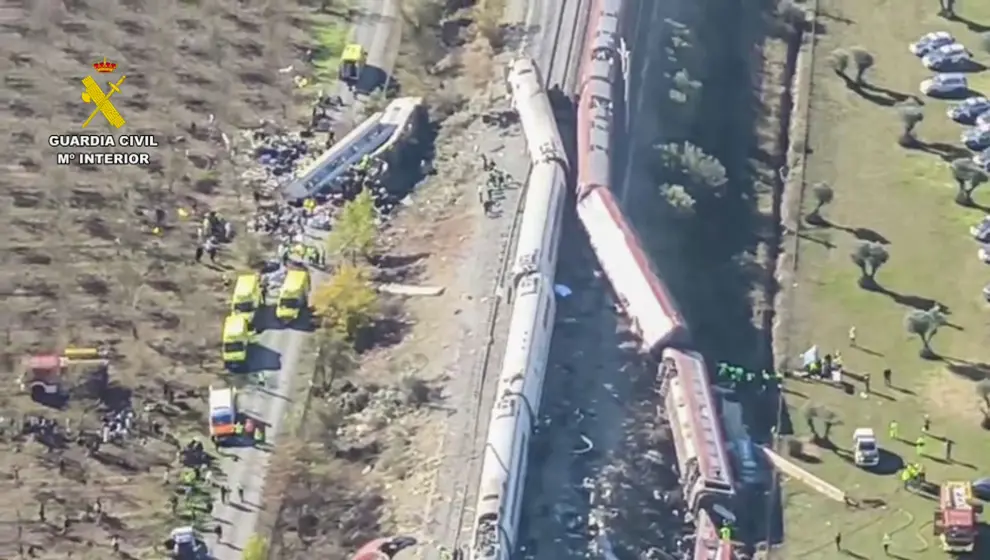
Aerial view of the trains involved in the Urda (Toledo) accident, 28 October 2026. Guardia Civil drone footage.EFE / Guardia Civil · 28 OCT 2026 ↗
A Renfe AVE struck the rear of an Iryo train stopped near Urda, Toledo. The most recent toll announced by Castilla-La Mancha is 68 deaths and remains provisional. The cause has yet to be established through the technical and judicial investigations. [1, 2]
The accident occurred on 28 October on the Madrid–Andalusia high-speed line. Both trains were operating the Madrid–Seville route. According to initial information released by the authorities, 151 people were aboard the Iryo train and 393 aboard the Renfe AVE. The collision left dozens injured; more than a hundred were receiving medical care in the regional update consulted. Services between Madrid, Ciudad Real and Andalusia were suspended. [1, 2]
The first figures released during an emergency change as rescue and identification progress. Therefore, 68 should be read as the latest provisional toll located, not a final figure. Behind each number are a life, a family and a community struck by loss.
The tragedy immediately raises a question: how can one train run into another on a line where traffic is organised to maintain safe separation? Images and initial descriptions cannot provide the answer. The task now is to reconstruct exactly what happened and explain what measures must follow.
OPINA NEWS 2405 · 29 OCT 2026 · Railway safety
Railway safety
Guardia Civil officers help survivors of the Urda (Toledo) train accident, 28 October 2026.EFE / Guardia Civil · 28 OCT 2026 ↗
HOW RAIL TRAFFIC IS PROTECTED
Modern railways operate through several coordinated safety barriers. Signalling divides the track into sections and regulates when a train may enter each one. Control centres oversee traffic; onboard systems receive information and, depending on their equipment, can warn the driver or intervene in braking. Protection depends on infrastructure, technology, procedures and human decisions acting consistently together.
That principle helps explain why a rear-end train collision demands a rigorous investigation. But it does not establish, before the data are analysed, that a particular system failed. Reconstructing the sequence requires checking speed and position records, signals received, communications, movement orders, equipment condition and possible infrastructure incidents.
Investigators must distinguish the immediate cause from contributing factors: maintenance, design, traffic management, available information or emergency procedures. An anomaly in a record does not, by itself, establish responsibility. A verifiable chronology and an independent technical assessment are needed.
The judicial investigation determines legal responsibility; the technical investigation seeks causes and preventive measures. Their findings may complement one another, but their functions differ. The public's urgency is understandable; attributing a cause without evidence can divert attention from what the investigation must establish.
HOW SAFE ARE TRAINS?
OPINA NEWS 2405 · 29 OCT 2026 · Railway safety
Railway safety
Overall, rail is among the safest forms of land transport. The European Union Agency for Railways estimated that, from 2012 to 2021, the average fatality risk for a rail passenger was 0.077 deaths per billion passenger-kilometres. Over the same period, the risk of dying in a car over an equivalent distance was approximately 30 times higher. This is a broad statistical comparison; it does not remove the risk of a serious accident. [3]
European statistics also show that most people killed in railway accidents were not travelling by train. In 2024, the EU recorded 750 deaths: 65.6% were people on railway premises without authorisation and 25.5% were level-crossing users. Passengers accounted for 2.1% of fatalities. These figures describe different risks and should not be combined as though every case were a train collision. [4]
Comparing countries involves more than counting deaths. It requires considering the numbers of trains and passengers, distances travelled, network length and the categories included in each record. Statistical methods also differ between world regions, limiting the usefulness of a simple global ranking.
Serious railway accidents are not unique to Spain. In 2023, the collision at Tempi, Greece, caused 57 deaths and exposed risks and failures that the authorities had to investigate. The conclusion is twofold: rail is usually very safe for passengers, and every major accident demands a specific review of the safety barriers involved. [5]
OPINA NEWS 2405 · 29 OCT 2026 · Railway safety
Railway safety
SPAIN: THE DATA AND THE TRAGEDY
Before the Urda accident, Spain showed favourable railway indicators in the available European comparisons. Eurostat recorded a rate of one death per thousand kilometres of track in 2023, among the lowest in the Union, against an EU average of 2.5. That figure covers different kinds of railway accidents; it does not measure only the risk of dying aboard a train. [6]
The European Union Agency for Railways' factsheet recorded 18 fatalities in Spain's railway safety statistics for 2024. That figure relates to an earlier year and cannot establish what happened in 2026. Nor can it alone describe the safety of every line, operation or user category. [7]
The Urda accident occurred in a year that had already seen other serious railway disasters, including Adamuz, Córdoba, in January. This succession of tragedies increases the need to review procedures and infrastructure, but does not prove that both accidents shared a cause. Each investigation must start from its own records and evidence. [2, 8]
This answers the front-page question: the problem is not confined to Spain, but that does not diminish the importance of what happened here. Earlier statistics put the system into perspective; the deaths at Urda now require checking whether protections worked on this corridor and correcting any shortcomings confirmed by the investigation.
OPINA NEWS 2405 · 29 OCT 2026 · Railway safety
Railway safety
FROM THE FIRST RAILS TO THE AVE
The history of Spanish rail began before Renfe existed. In 1837, the line between Havana and Güines opened in Cuba, then under Spanish rule. On the peninsula, the first railway was Barcelona–Mataró, inaugurated on 28 October 1848. That journey began a transformation that would connect cities and change the movement of people and goods. [9]
In 1941, following the reorganisation and nationalisation of several companies, the Red Nacional de Ferrocarriles Españoles, Renfe, was established. Decades of electrification and modernisation followed. High-speed rail took shape in 1992 with the Madrid–Seville line, whose commercial services began on 21 April, the year of Seville's Expo. The line opened a new era of rail connectivity in the country. [9, 10]
Innovation has been central to that history, but so has continuous maintenance. A modern network requires ongoing inspections, updated equipment, trained staff and coordination between operators and the infrastructure manager. Safety is not secured forever when a line opens: it rests on everyday decisions and controls that must keep working.
Recalling railway history does not anticipate the causes of Urda. It does help explain why every tragedy must produce verifiable lessons. Technology that enables faster journeys must be accompanied by protection systems, investment and oversight capable of responding to the network's real conditions.
OPINA NEWS 2405 · 29 OCT 2026 · Railway safety
Railway safety
THE UNANSWERED QUESTIONS
The investigation must answer specific questions: why the Iryo train was stopped; what information both trains and the control centres received; which protection systems were active; and what speed, position and communication records show. It must also examine infrastructure condition, maintenance and the procedures applied. Until findings exist, presenting a hypothesis as a confirmed cause is irresponsible.
A clear public explanation must follow. Families need information and support; passengers and workers need to know what measures are being taken; society needs to understand what failed and what will change. Transparency does not replace technical work, but is necessary to restore trust.
Findings must translate into measurable action: remedy confirmed deficiencies, verify the effectiveness of protection systems, ensure maintenance and assess each corridor's risks. The safety review must also cover procedures and coordination between those managing the track and those running the trains.
European data remind us that rail remains, on average, one of the safest means of passenger transport. The provisional toll of 68 deaths reminds us that no system can take that safety for granted. Urda leaves a concrete question: what happened on this line, which barriers proved insufficient, and what must change to prevent a recurrence?
CLOSING NOTE Provisional toll of 68 deaths attributed to the management of Castilla-La Mancha's emergency plan, according to the latest communication consulted on 28 October 2026. The accident's cause has not been established. Research-based report; it contains no original interviews and is not presented as an eyewitness account.
BALLON D’OR 2026 | A night to take its place in history
An illustrated Ballon d’Or special: the protagonists, the honours and the history.
Harry Kane, archive photograph from 2023. It does not depict the 2026 awards ceremony.Simon Walker / No 10 Downing Street, Wikimedia Commons. CC BY 2.0: https://creativecommons.org/licenses/by/2.0/ . Recorte preexistente.
FOOTBALL IN THE LIGHT OF GOLD
An individual award always tells a collective story. Behind one name stand teammates, coaches, opponents and an entire season of decisions. The Ballon d’Or turns that journey into an image: a footballer and a trophy that seeks to sum it all up.
The latest ceremony, held on 26 October 2026, had two main protagonists: Harry Kane and Alexia Putellas. The London Palladium hosted the ceremony in London for the first time, in the award’s 70th-anniversary year. The English capital also offered a connection with its beginnings: Stanley Matthews became the first winner in 1956.
TWO PATHS, ONE STAGE
The English striker and the Spanish midfielder represent different ways of influencing a match. One turns the penalty area into a destination; the other makes the circulation of the ball a form of governance. Looking at them together reminds us that excellence has different languages.
This special follows their awards, broadens the focus to the other honours and revisits the milestones that have given the Ballon d’Or its place in football’s conversation. Archive photographs are identified as such: they accompany the story and are not presented as images of the ceremony.
IN THIS SPECIAL 17 · Kane, the value of persistence. 18 · Alexia, the mark of a creator. 19 · A ceremony with many signatures. 20 · Seventy years of memories.
OPINA NEWS 2405 · 29 OCT 2026 · Ballon d’Or
Ballon d’Or
Harry Kane, archive photograph from 2023. It does not depict the 2026 awards ceremony.Simon Walker / No 10 Downing Street, Wikimedia Commons. CC BY 2.0: https://creativecommons.org/licenses/by/2.0/ . Recorte preexistente.
PATIENCE SCORES TOO
Some careers are explained by a breakthrough; others ask us to observe continuity. Kane belongs to the second story: the striker whose presence makes us look again at the craft of finishing. His 2026 victory allows the award to be read through that idea of persistence.
According to UEFA, the Bayern forward finished ahead of Kylian Mbappé and Lamine Yamal. At 33, he became the first English winner since Michael Owen, honoured in 2001. He also received the Striker of the Year award.
THE SEASON IN NUMBERS
The official record lists 73 goals for club and country in the 2025/26 season. He scored 14 in the Champions League and Bayern reached the semi-finals. In Germany, he led the Bundesliga scoring chart for a third consecutive season, as part of a domestic treble for the Bavarian club.
THE NUMBER NINE AS A MEETING POINT
Statistics provide an entry into the story, but should not be mistaken for a complete description of the game. A shot contains earlier movements, spaces created and passes that do not always appear in the scorer’s photograph. An attacker’s award also invites us to look at those who enable him to receive the ball in a position to decide.
OPINA analysis: the narrative strength of this victory lies in its duration. Excellence can be a demanding repetition: offering an answer again when the opponent already knows the question.
Alexia Putellas, archive photograph from 2016. It does not depict the awards ceremony.Electro07, recorte de PeeJay. CC BY-SA 4.0 https://creativecommons.org/licenses/by-sa/4.0/
WRITING YOUR OWN NAME AGAIN
Alexia Putellas’s third Ballon d’Or connects different periods of the same career. A winner in 2021 and 2022, the Spanish midfielder leads the women’s award again in 2026, ahead of Ewa Pajor and Khadija Shaw.
UEFA’s official profile includes the Champions League won with Barcelona among the arguments for her season. In that European campaign she contributed seven goals and seven assists and was named the competition’s best player. She was also recognised as the best player in the Nations League finals that she won with Spain.
ONE SEASON, TWO SHIRTS IN THE RECORD
The honours list identifies Alexia as a Barcelona and London City Lionesses player. The explanation is chronological: after the award-winning season with Barcelona, she joined the English team for 2026/27. That distinction avoids crediting her new club with earlier results.
THE LOOK BEFORE THE PASS
Rewarding a midfielder invites attention to actions less emphatic than the final shot. Receiving with the right body position, maintaining continuity and recognising a teammate’s position are ways of changing what happens next. Not all end in a statistic; all help put a question to the spectator: who made the move possible?
OPINA analysis: Alexia’s interest as a protagonist lies in this relationship between authorship and team. The individual name stands out because the game she organises belongs to many.
Lamine Yamal at the 2026 World Cup. It does not depict the awards ceremony.Bryan Berlin / WikiPortraits. CC BY-SA 4.0 https://creativecommons.org/licenses/by-sa/4.0/
BEYOND THE TWO GREAT TROPHIES
A ceremony can be read through its protagonists or through the map drawn by its awards. In London, young talent bore the names of Lamine Yamal and Vicky López. The goalkeeping honours went to Unai Simón and Cata Coll. Two positions in which a decision lasts an instant and can shape an entire match.
THE DUGOUTS AND THE CLUBS
Luis de la Fuente and Pere Romeu received the coaching awards for men’s and women’s teams respectively. Paris Saint-Germain was recognised as the men’s club and Barcelona as the women’s club. The striker honours went to Harry Kane and Charlyn Corral, the Mexican Pachuca player.
THE OTHER SPOTLIGHT
The Sócrates Award, devoted to solidarity initiatives and social causes, went to Bukayo Saka. Its place in the programme reminds us that football’s public relevance is also measured beyond the pitch.
HOW TO READ THIS LIST
These honours bring together different categories. They do not represent a single ranking of players, coaches and clubs. Nor should the young-talent award be confused with the overall Ballon d’Or: Yamal received the former and finished third in the latter.
OPINA analysis: widening the frame makes the ceremony more interesting. Football needs the visible gesture of the goal, but also the work that prepares, sustains or prevents it. A page of awards can help us look again at the whole match.
THE IMAGE Lamine Yamal during the 2026 World Cup. The photograph illustrates the award winner; it does not document him receiving the trophy.
OPINA NEWS 2405 · 29 OCT 2026 · Ballon d’Or
Ballon d’Or
THE FIRST NAME
France Football created the Ballon d’Or in 1956. The first winner was Stanley Matthews. Seventy years later, the London ceremony makes a symbolic connection with that English beginning.
A TIMELINE TO REMEMBER
1957 and 1959 · Alfredo Di Stéfano leaves his signature on two editions. 1960 · Luis Suárez adds a Spanish name to the honours list. 1963 · Lev Yashin, a goalkeeper among the winners. 1971, 1973 and 1974 · Johan Cruyff collects three awards. 1983–1985 · Michel Platini wins three in succession. 1995 · George Weah writes Liberia into the trophy’s history. 2008–2017 · Cristiano Ronaldo and Lionel Messi share every edition in that decade. 2018 · Luka Modrić breaks the sequence; Ada Hegerberg inaugurates the women’s award. 2020 · The award is not presented. 2023 · Messi reaches his eighth victory; Cristiano has five across his career. 2024 · Rodri succeeds Messi. 2025 · Ousmane Dembélé and Aitana Bonmatí lead the men’s and women’s honours. 2026 · Kane and Alexia write the next line.
TIME CHANGES OUR VIEW TOO
A list of winners works like a library of memories: every reader associates a name with a dribble, a stadium or a conversation. Yet the honours alone do not contain the whole history of the sport. Remembering that allows us to enjoy tradition without reducing an era to a single victor.
The introduction of the women’s award in 2018 broadened that official memory. Looking ahead means continuing to make room for the game and the careers that the trophy helps us discover.
OPINA’S CLOSING THOUGHT Gold fits inside a display case. What makes it endure happens on the pitch and in the memories of those who watched.
OPINA NEWS 2405 · 29 OCT 2026 · Dignity and living conditions
Dignity and living conditions
Living with dignity: what a society refuses to normalise
An anthropological perspective on housing, social protection and the language through which we recognise—or erase—other people.
Minglun social housing, Taipei, 4 March 2023. Contextual architectural photograph: it does not document poverty or degrading conditions and does not establish the circumstances of its residents.Solomon203 / Wikimedia Commons CC BY-SA 4.0 · https://creativecommons.org/licenses/by-sa/4.0/ ↗
THE PERSON BEFORE THE LABEL
The expression “living like dogs” may condemn intolerable conditions, yet it can also transfer humiliation onto those enduring them. This report changes the question: instead of treating people as less human, it examines the conditions that prevent security, privacy and choice. Precarity describes a situation; it never determines a person’s worth.
From an anthropological perspective, everyday life reveals social hierarchies. Who can close a door, rest without fear or be heard says something about the distribution of recognition. This is an editorial interpretation, not a claim that all cultures or experiences of poverty are identical. Dignity does not begin when somebody obtains a home, job or document. The Universal Declaration recognises it as inherent to every human being. [1]
OPINA NEWS 2405 · 29 OCT 2026 · Dignity and living conditions
Dignity and living conditions
A HOME IS MORE THAN A ROOF
Housing exposes the distance between surviving and inhabiting. The United Nations framework includes security of tenure, services, affordability, habitability, accessibility, location and cultural adequacy. A dwelling may physically exist without enabling a safe, stable life. [2]
The social meaning of a home extends beyond floor area. Can someone care for a relative, store belongings, prepare food or maintain relationships without constant exposure? These questions assess the opportunities an environment offers, rather than judging occupants’ habits. A photograph of a building cannot answer them. Nor can it establish the poverty, income or well-being of the people inside.
OPINA NEWS 2405 · 29 OCT 2026 · Dignity and living conditions
Dignity and living conditions
INSECURITY THAT REMAINS INVISIBLE
Social protection adds another dimension. The ILO’s World Social Protection Report 2024–2026 states that 52.4% of the population received at least one cash social protection benefit in 2023, while 3.8 billion people had no coverage. This is a dated indicator, not a live count for October 2026; receiving one benefit does not mean adequate protection against every risk. [3]
The figure suggests a practical question: what happens when income stops or care needs disrupt a routine? The answer cannot rest solely on individual endurance. A family may possess skills, plans and strong relationships and still have no room to absorb an emergency. Recognising this allows discussion of institutional responsibility without portraying people as powerless.
OPINA NEWS 2405 · 29 OCT 2026 · Dignity and living conditions
Dignity and living conditions
LANGUAGE SHAPES THE WAY WE LOOK
Words can open a conversation or close it before it starts. When somebody becomes only “a problem”, it becomes easy to discuss what to do with that person without hearing what they need. Responsible reporting should ask how people wish to be identified, what they want to share and what consequences publication might have.
Poverty does not automatically supply consent to photograph a face, home or intimate moment. Nor does one person’s experience explain an entire neighbourhood. This feature uses a contextual architectural photograph: it depicts social housing in Taipei and neither documents degrading conditions nor supports conclusions about residents. Images should provide verifiable context, not manufacture emotion at someone else’s expense.
OPINA NEWS 2405 · 29 OCT 2026 · Dignity and living conditions
Dignity and living conditions
ASSISTANCE, VOICE AND CHOICE
A society can provide assistance while treating its recipients as spectators in their own lives. The editorial question is whether solutions incorporate their experience. Are procedures explained? Can errors be corrected? Can someone disagree without losing the respect of the person assisting them?
Asking is no substitute for technical evaluation and does not guarantee good policy. It does reveal the difference between receiving something and participating in a decision affecting one’s life. The Universal Declaration connects social security, work, rest and an adequate standard of living with human dignity. It offers a rights framework, not a moral ranking of who deserves help. [1]
OPINA NEWS 2405 · 29 OCT 2026 · Dignity and living conditions
Dignity and living conditions
A MEASURE OF SHARED LIFE
Criticism of undignified conditions should address what can change: barriers to access, humiliating treatment, inadequate services or decisions that prevent safe lives. Measuring progress matters. Announcing action is not enough; we should ask whom it reaches, what it resolves and which obstacles remain.
This report contains no original interviews or diagnosis of a particular country. It proposes an interpretation: communities can also be understood by observing whom they leave waiting and why they fail to listen. Living conditions never diminish anyone’s humanity. The collective task is to change those conditions while preserving the recognition, privacy and voice of the people experiencing them.
OPINA NEWS 2405 · 29 OCT 2026 · Economy and markets
Economy and markets
Money, rates and earnings: the keys to a demanding week
European inflation, the Federal Reserve’s decision and technology earnings shape the agenda. An international reading that separates a company’s business from its share price.
Frankfurt, 3 January 2023. Archive photograph for economic context; it does not depict an October 2026 monetary-policy meeting.Flocci Nivis (Livia Rasp) / Wikimedia Commons · CC BY 4.0 · Image may be fitted to layout; preserve this credit. https://creativecommons.org/licenses/by/4.0/ ↗
THE PRICE OF MONEY
The week of 26–28 October brings a combination requiring careful reading: inflation, monetary policy and company earnings. Information for this issue closes on 28 October 2026. This is not a ranking of the shares most likely to rise, but a map for understanding what is changing and what to ask before investing.
On 28 October the Federal Reserve maintained its target range at 3.75–4%. [1] In the euro area, the ECB deposit facility rate stood at 2.50%, effective from 16 September. [2] These are different monetary-policy references: neither equals the return every saver receives or the specific cost of any loan.
OPINA analysis: comparing international opportunities requires attention to financing costs, currency and time horizon. A company can increase sales while its customers or suppliers face harder conditions. Interest rates help frame that question, but do not replace an examination of the accounts. Nor do they guarantee a stock-market outcome.
OPINA NEWS 2405 · 29 OCT 2026 · Economy and markets
Economy and markets
INFLATION RETURNS TO THE CENTRE
Eurostat put annual euro-area inflation at 3.8% in September, against 3.2% in August. [3] These Harmonised Index of Consumer Prices figures were published on 16 October; they do not describe each family’s particular shopping basket. The effect on a household also depends on spending, income and contracts.
The statistical agenda remained open at the cutoff: Eurostat scheduled the third-quarter GDP flash estimate and September unemployment for 29 October. [4] This issue neither anticipates those results nor confuses a forecast with published data. The calendar matters as much as the headline: analyses written hours apart may have different information available.
OPINA analysis: higher inflation invites scrutiny of company margins and purchasing power, without making one aggregate figure an automatic explanation for every business. A manufacturer, a retailer and a software provider may pass on costs differently. Before comparing profits, ask how much comes from more units sold, different prices or a changing product mix.
OPINA NEWS 2405 · 29 OCT 2026 · Economy and markets
Economy and markets
BIG TECHNOLOGY UNDER SCRUTINY
On 28 October Microsoft reported quarterly revenue of $92.3 billion, up 19% year on year. [5] On 21 October SAP had reported 13% growth in total third-quarter revenue. [6] These are examples of published company accounts, not a global sales ranking or a recommendation to buy.
OPINA analysis: the size of a brand and an investment’s performance are different questions. Revenue, operating profit, net income and cash generation should be separated. Comparing amounts in different currencies or periods without saying so can create misleading precision. It also matters whether a measure follows accounting rules or is adjusted by the company.
A useful sequence for reading a company is to identify its activity, check the report’s date and period, separate realised results from expectations, and examine risks. Valuation comes next: the price paid matters as much as the perceived quality of the business. A compelling commercial story does not remove the possibility of shareholder losses.
VOLUME, VALUE AND DISCIPLINE
Nasdaq explains that its monthly statistics aggregate share volume, trade counts and positions; October had not yet ended. [7] We therefore publish no definitive table of the month’s most-traded stocks. High volume alone does not mean more net buying: every executed trade has both a buyer and a seller.
OPINA NEWS 2405 · 29 OCT 2026 · Economy and markets
Economy and markets
OPINA analysis: market capitalisation, revenue and volume are not synonyms. The first expresses stock-market value; the second, company sales; the third, trading activity. Choosing a familiar brand without distinguishing those magnitudes mixes three different stories. A chart needs a date, currency, unit and source so readers can interpret it.
A weekly review can follow three questions: what fact has changed, what economic effect might it have, and what remains unknown? Check original sources and avoid decisions based solely on a few hours’ movements. Diversification, understanding costs and matching the investment horizon to personal needs are planning issues, not promises of returns.
This overview provides journalistic context, not a personalised portfolio or a profit guarantee. Published results may be revised and share prices change. Discipline begins by recognising that difference: data informs; an investment decision also requires assessing risks, circumstances and the capacity to absorb losses.
OPINA NEWS 2405 · 29 OCT 2026 · Dogs, bicycles and scooters
Dogs, bicycles and scooters
When the wheels go by: understanding dogs and sharing space
Bicycles, scooters and people in motion can trigger fear, excitement or the urge to chase. Recognising the difference helps protect dogs, their handlers and riders.
Context photograph taken on 8 September 2023: a dog with a bicycle. It does not show an anxiety reaction or constitute a transport recommendation.AmarilloCalabacin / Wikimedia Commons · CC BY-SA 4.0 · Reproducción sin alteración del archivo original. https://creativecommons.org/licenses/by-sa/4.0/ ↗
ONE SCENE, DIFFERENT EMOTIONS
A walk changes in seconds: a bicycle approaches, someone passes on a scooter, and the dog freezes, pulls on the lead or barks. The reaction can surprise the rider. For the person accompanying the dog, it can become a daily concern. This scene brings animal welfare, mobility and safety together: understanding it helps prevent conflict between people sharing space.
Not every bark means anxiety, and not every chase is aggression. Dogs Trust distinguishes responses linked to fear, excitement about movement and frustration. One dog may try to drive away something worrying; another may be drawn to the chase. The same visible behaviour can have different motivations and needs to be considered in context. [1]
The person riding matters too. A bicycle against a wall and an approaching cyclist are not equivalent situations. Direction, speed, noise and distance change the encounter. A single incident should not be used to attribute a general dislike of cyclists, children or people with a particular appearance to a dog. The useful question is what happened before, during and after the reaction.
OPINA NEWS 2405 · 29 OCT 2026 · Dogs, bicycles and scooters
Dogs, bicycles and scooters
A person riding an electric scooter. Context photograph: it does not document an incident involving dogs or imply misconduct by the rider.Arindam Raha / Pexels https://www.pexels.com/license/ ↗
READING THE BODY BEFORE THE BARK
The RSPCA describes signs of discomfort such as lowering the head, pulling the ears back, looking away or licking the lips. A stiff body, fixed stare or exposed teeth call for space. No isolated signal diagnoses an emotion: posture, surroundings and history must be read together. Even a wagging tail does not guarantee that the dog is comfortable. [2]
Dogs Trust adds that becoming still, trying to move away or losing the ability to pay attention may indicate that a situation is overwhelming. These observations help people act before an encounter ends in pulling. There is no need to wait for a major outburst before crossing the street or choosing a quieter route. [3]
A short record can improve a discussion with a professional: location, approximate distance, vehicle type, reaction intensity and recovery time. Recording video is useful only if another person can do it without provoking an episode or neglecting safety. The aim is to understand a pattern, not capture dramatic footage.
For cyclists and scooter riders, anticipating creates more room than arguing. As a proposal for sharing space, slow down early, allow separation and avoid sudden approaches where conditions permit. If there is no safe passage, stopping somewhere suitable and agreeing how to pass is wiser than squeezing past a lead. Local traffic rules remain the reference.
OPINA NEWS 2405 · 29 OCT 2026 · Dogs, bicycles and scooters
Dogs, bicycles and scooters
LEARNING WITHOUT PUNISHMENT
The American Veterinary Society of Animal Behavior recommends reward-based methods for teaching skills and changing behaviour. It rejects procedures involving pain, fear or intimidation. Learning should offer the dog a response it can perform, rather than turning every encounter into a correction. [4]
For work around bicycles or scooters, Dogs Trust recommends a distance at which the dog can remain calm, well-fitting equipment and rewards for calm responses. Training is prepared under manageable conditions; it is not about forcing an animal to endure a stream of vehicles too close by. Preventing chasing is part of the process. [1]
The details depend on the individual. A session might simply involve watching from a distance and leaving without a fright. Progress need not be measured by how close a scooter gets: it may also appear in recovery, renewed exploration or responding to a familiar cue. A difficult encounter is a reason to reconsider the context, not increase pressure.
The rider must not become an unwilling training assistant either. Any arranged practice requires consent, suitable space and risk control. Traffic routes and crowded places are not laboratories for testing how much a dog can tolerate.
OPINA NEWS 2405 · 29 OCT 2026 · Dogs, bicycles and scooters
Dogs, bicycles and scooters
WHEN TO SEEK HELP AND WHAT TO CHANGE
The Merck Veterinary Manual stresses ruling out physical problems when behaviour changes: pain may contribute. Sudden onset, increasing intensity or difficulty managing encounters justify consulting a veterinarian. A plan may include environmental management and specialist support; this feature cannot replace an individual assessment and does not prescribe medication. [5]
While seeking guidance, quieter times and routes with room to move aside can ease daily organisation. The aim is not to exclude a dog from urban life forever, but to allow walks compatible with its welfare and other people's safety.
Sharing space improves when everyone retains room to act: the handler observes and prevents; the rider anticipates and avoids surprises; the space allows separation. A bark need not be interpreted as a personal insult, nor a bicycle as an inevitable enemy. Often the first step is simpler: reduce the intensity of the encounter so everyone can continue on their way.
Germany changes competitions without easing the pace
The cup brings big wins and eliminations, with Bayern–Dortmund approaching. Verified results and the following week’s schedule, using German local times.
Allianz Arena, Munich, 29 October 2011. Archive photograph; it does not show the matches played in October 2026.Matti Blume / Wikimedia Commons · CC BY-SA 4.0. Sin modificación del archivo original; el encuadre puede ajustarse en maquetación. https://creativecommons.org/licenses/by-sa/4.0/ ↗
CUP NIGHT
The German Cup’s second round made 27 and 28 October two days of knockout football. The DFB’s official record consulted for this edition lists Wednesday’s results as Bayern 6–1 Magdeburg, Leverkusen 5–2 Nuremberg, Hannover 0–2 Kaiserslautern, Dresden 2–0 Schalke, Freiburg 3–2 Wolfsburg, Paderborn 0–1 Stuttgart and Jeddeloh 0–2 Hertha. Its general page still showed no final result for Kiel–Hoffenheim; that score is omitted rather than treating an incomplete update as a confirmed outcome. [1]
On Tuesday, Dortmund had beaten Bremen 3–2, Frankfurt had won 3–1 in Hamburg and Cologne had defeated Union Berlin 5–0. The cup brings title contenders and teams seeking to extend an exceptional opportunity into the same conversation. The result decides who progresses; reading a match requires more than its winning margin. [1]
OLISE AND BAYERN’S RESPONSE
OPINA NEWS 2405 · 29 OCT 2026 · German football
German football
Michael Olise was particularly prominent in Munich’s 6–1 victory: he scored twice and assisted Ismael Saibari. Magdeburg had equalised through Mateusz Żukowski before Saibari restored Bayern’s lead. Olise’s second, a penalty, was followed by goals from Alphonso Davies, Nathaniel Brown and David Santos Daiber. Bundesliga’s official account establishes that sequence without suggesting the same level of superiority throughout all ninety minutes. [2]
Harry Kane did not start that night. In his absence and that of Luis Díaz, other players shared the attacking output. It is a useful point for readers: a team can remain dangerous without reproducing its usual line-up. That alone does not establish how it will respond to different opponents. [2]
OPINA’s reading: the win’s sporting value also lies in the distribution of responsibility. Assessing Olise means observing where he receives the ball, his combinations and his involvement before the finish. Verified actions provide evidence; predictions about the next game remain interpretations.
OPINA NEWS 2405 · 29 OCT 2026 · German football
German football
THE IMMEDIATE APPOINTMENT
The confirmed schedule places Bayern–Borussia Dortmund at the Allianz Arena on Saturday 31 October at 18:30 German time. Bayern’s post-match coverage identifies this fixture as the team’s next reference point. The cup win provides context, but cannot anticipate the outcome of a game still unplayed at this edition’s close. [3, 4]
For viewers, the interest lies in testing attacking fluency against a different opponent’s ability to restrict space. Final line-ups and recovery after the cup will matter too. Unverified absences and predicted teams are not presented here as confirmed information.
NEXT WEEK
Bayern’s official schedule sets the trip to Mainz for Saturday 7 November at 15:30. Matchday nine also includes Hamburg–Mönchengladbach on Friday 6 November; Leipzig–Augsburg and Dortmund–Elversberg on Saturday 7; and Cologne–Leverkusen on Sunday 8. These are scheduled fixtures, not results. Check timings before travelling or buying a ticket. [5, 6]
OPINA NEWS 2405 · 29 OCT 2026 · German football
German football
There is no further cup round to settle the following week: the DFB schedules the round of sixteen for 1 and 2 December. The calendar separates league continuity from the next knockout stage. For a weekly magazine, distinguishing the competitions prevents a cup break from being presented as an absence of football. [7]
FOLLOWING THE STORY
Three questions will accompany the coming games: whether Bayern’s scoring will remain shared; how Dortmund will respond in Munich; and which teams can carry cup momentum into the league. These are editorial questions, not guaranteed forecasts. Answers will emerge through complete matches and fresh evidence.
Closing note: checked on 29 October 2026. Scores follow the cited records. Archive photographs do not document these matches. Times expressly stated are local to Germany.
OPINA NEWS 2405 · 29 OCT 2026 · Medicine and research
Medicine and research
Medicine that changes lives: from the laboratory to real care
Gene editing, Alzheimer’s diagnosis, immunotherapy and vaccines: four research frontiers, their achievements and limits, and the decisive question of access.
A researcher examines a sample under a microscope. NCI archive photograph, 27 January 2005; it does not depict a 2026 trial or treatment.Diane A. Reid / National Cancer Institute (NCI), NIH · 27 January 2005 · Public domain https://creativecommons.org/publicdomain/mark/1.0/ ↗
READING THE EVIDENCE
A medical advance is more than a new molecule. It may be a less invasive test, a treatment that changes a disease’s course or a vaccine reaching a health centre. Understanding progress means separating three stages: discovering a possibility, demonstrating benefit in patients and turning it into accessible care. This feature brings together documented milestones; it does not present them as this week’s announcements.
Gene editing illustrates that journey. On 8 December 2023, the US FDA approved Casgevy for certain patients with sickle cell disease, its first authorised treatment using CRISPR/Cas9. The technology modifies a patient’s own blood stem cells outside the body before returning them. It does not alter every gene in a person or create an intervention passed on to their descendants.
Its significance lies in addressing a biological mechanism of an inherited disease. Authorisation does not make the procedure simple. It requires cell collection, specialised manufacturing, preparation of the body and prolonged follow-up. Treatment risks and long-term uncertainties are part of the same story as the benefit.
Initial approval and subsequent indications must be read with their date and jurisdiction. US authorisation does not automatically mean availability everywhere. Journalism’s questions continue beyond the laboratory: which centres can deliver it, with what capacity and for which patients?
OPINA NEWS 2405 · 29 OCT 2026 · Medicine and research
Medicine and research
ALZHEIMER’S: GAINING TIME AND IMPROVING DIAGNOSIS
Alzheimer’s research has opened two connected fronts. One seeks to modify the disease’s course; the other aims to identify more precisely what is happening. Confusing them produces misleading headlines: detecting a biological signal is not a cure, and slowing decline does not mean restoring every lost ability.
The FDA approved donanemab, marketed as Kisunla, on 2 July 2024. This antibody targets beta amyloid, and treatment initiation was studied in early disease, with mild cognitive impairment or mild dementia. That scope matters: results should not be extended without evidence to every disease stage or every memory problem.
Treatment requires assessment of significant risks, including amyloid-related imaging abnormalities that may involve brain swelling and bleeding. Specialist monitoring is part of the process. Benefits and risks must be interpreted together; regulatory authorisation does not remove that assessment.
In May 2025, the FDA cleared the Lumipulse G pTau217/β-Amyloid 1-42 Plasma Ratio for marketing as a diagnostic aid in a specific clinical setting. A blood draw can help assess amyloid pathology, but this is neither a stand-alone diagnostic test nor general screening for healthy people. Results are combined with clinical history and other evaluations. Progress also means reducing uncertainty without promising certainty the test cannot provide.
OPINA NEWS 2405 · 29 OCT 2026 · Medicine and research
Medicine and research
CANCER: TRAINING THE BODY’S DEFENCES
Immunotherapy has changed the thinking behind some cancer treatments: as well as attacking a tumour directly, researchers can try to direct the immune response. Within this field, CAR-T therapies modify T cells to recognise particular cellular signals. “Training the defences” explains the principle, although a complex clinical and manufacturing chain lies behind it.
The US National Cancer Institute describes authorised CAR-T treatments for specific blood cancers. That does not justify talking about a universal cancer cure. Tumours are not a single disease: their characteristics, previous treatments and individual responses differ. Applying a strategy to other tumour types requires its usefulness to be demonstrated again.
Biological power also explains serious risks. Cytokine release can cause intense inflammation, and neurological problems or infections may occur. In April 2024, the FDA required prominent warnings about T-cell malignancy risk following certain autologous CAR-T immunotherapies targeting BCMA or CD19. Long-term follow-up remains essential.
Research compares outcomes, improves patient selection and examines safer, more accessible processes. When reading a trial report, ask how many people participated, what comparison treatment was used and how long they were observed. A tumour response matters, but by itself it does not establish longer survival or predict an individual outcome.
OPINA NEWS 2405 · 29 OCT 2026 · Medicine and research
Medicine and research
VACCINES AND ACCESS: PROGRESS THAT ARRIVES
International medicine is not measured only by its most sophisticated technology. Preventing disease in an exposed population can change thousands of families’ lives. The RTS,S/AS01 and R21/Matrix-M malaria vaccines illustrate innovation that must be read alongside the organisation of health services.
WHO recommends their use to prevent Plasmodium falciparum malaria in children living in endemic areas, prioritising moderate and high transmission settings. Its May 2024 position paper and updated questions and answers explain that vaccination belongs within a comprehensive strategy. It does not replace bed nets, vector control, diagnosis or timely treatment.
Responsible comparison avoids treating percentages from different studies as a direct competition. WHO says RTS,S and R21 have not been compared in a head-to-head trial, and there is no evidence establishing one as superior. Programme choices include supply, cost and delivery capacity.
Between laboratory and patient stand practical decisions: staffing, storage, transport, financing and continuity. An extraordinary therapy may remain beyond the reach of those who need it. An available vaccine may arrive too late if the system fails.
The editorial conclusion is concrete: progress combines clinical benefit, safety and access. Explaining that combination in a weekly publication offers more than a parade of supposed miracle cures. The dated milestones here are verifiable references, not individual treatment recommendations.
Six pages separating real flights, systems under development and long-term promises, from suborbital hops to future private stations.
AI-generated editorial illustration. It represents mission categories, not exact vehicles or a real mission.OPINA NEWS 24 · Ilustración editorial original / AI-generated editorial illustration Ilustración editorial OPINA NEWS 24 ↗
ONE MARKET, MANY JOURNEYS
The familiar image of space tourism is Earth seen through a window. Yet that picture brings together different businesses: suborbital hops, missions remaining in orbit and institutional transport of astronauts and supplies. A rocket, capsule, mission organizer and station may belong to different companies. Not every participant sells seats, and not every vehicle carries people.
At the 29 October 2026 editorial cutoff, SpaceX operates orbital crew transport with Dragon; Axiom Space organizes private missions using that transport. Blue Origin has suspended New Shepard to concentrate resources on lunar capabilities. Virgin Galactic is preparing its next spacecraft for an expected commercial return in 2027. Boeing continues validating Starliner. These are different operating states. [1–5]
Nor is this simply a luxury holiday industry. Governments purchase transport; researchers need microgravity; manufacturers study processes and materials; suppliers deliver provisions. The passenger experience forms part of a wider industrial chain whose continuity depends on customers, funding and reliability.
An orbital mission is not bought like an ordinary airline ticket. It requires preparation, technical integration and operational coordination. The useful questions are what service exists, who delivers it and what remains a target. This feature deliberately separates demonstrated operations, upcoming tests and long-term visions. Dates belong to the cited sources; they are not departure guarantees.
OPINA NEWS 2405 · 29 OCT 2026 · Space travel
Space travel
MINUTES OF WEIGHTLESSNESS
A suborbital flight rises and returns without completing an orbit of Earth. It offers a short period of free fall, unlike the days or weeks of an orbital stay. Blue Origin’s New Shepard uses a rocket and capsule; Virgin Galactic uses a winged spacecraft initially carried by a mothership aircraft. Architecture and mission profile matter as much as altitude.
On 30 January 2026 Blue Origin announced a New Shepard pause lasting at least two years, redirecting resources toward human lunar capabilities. Its passenger flight record therefore should not be presented as a service with confirmed current departures. An experience that has taken place can cease to be available. [2]
Virgin Galactic reported Apeiron’s arrival at Spaceport America beneath the Eve aircraft on 28 October. This was a transfer to prepare for testing, not a commercial passenger spaceflight. The company expects commercial flights in early second-quarter 2027, with a second ship following in late second or early third quarter. Those expectations depend on testing and validation. [3]
Stratospheric balloons belong to another category: reaching high altitude is not reaching orbit. A responsible comparison asks about trajectory, the duration of weightlessness, preparation and return. A dramatic image alone does not explain the experience or its demands.
OPINA NEWS 2405 · 29 OCT 2026 · Space travel
Space travel
SPACEX AND AXIOM: DIFFERENT ROLES
Falcon 9 provides the launch and Dragon the crew spacecraft for SpaceX. NASA certified the system for its crew transportation program in 2020. Institutional work helped build infrastructure that also serves private missions. This does not turn every flight into tourism: agency crew rotations serve public objectives and specific requirements. [1]
Axiom Space contributes mission organization, training and activity integration. For Ax-1 it contracted SpaceX for transportation using Falcon 9 and Dragon. Organizer and carrier occupy different positions in the same chain. NASA and International Space Station partners also coordinate access to the orbiting laboratory. [6]
NASA ordered Axiom’s fifth private mission to the station, targeted no earlier than January 2027 and lasting up to fourteen days aboard. The precise date depends partly on spacecraft traffic. An order is neither a completed mission nor a guaranteed tourist departure. [7]
A private mission may combine research, national representation, sponsorship and personal experience. Orbital flights independent of the station also exist. The essential distinction is the destination and contracted service: transportation, accommodation, experiments or an entire mission. The brand most visible in advertising need not manufacture every component enabling the journey.
OPINA NEWS 2405 · 29 OCT 2026 · Space travel
Space travel
THE NEXT DESTINATION IS STILL BEING BUILT
Commercial stations aim to provide workplaces beyond the current international station. NASA supports several designs and capabilities, but a development agreement is not an already operational habitable facility. Axiom Station, Orbital Reef and Starlab belong to this industrial transition. [8]
Starlab brings together Voyager Technologies, Airbus and international partners. Airbus describes an integrated station launched on one Starship flight, with a planned launch in 2029. It combines research and commercial activity. These are project features and targets, not a laboratory already welcoming customers. [9]
Vast is developing Haven-1. NASA also selected it for a private mission to the international station no earlier than summer 2027, using SpaceX transport. The initiatives are related but distinct: organizing a visit to an existing station does not establish that its own station is finished. [10]
Logistics completes the picture. Northrop Grumman supplies cargo with Cygnus; Sierra Space is preparing Dream Chaser, a cargo vehicle returning to a runway. In September Sierra announced payload contracts for its inaugural mission. Neither should be presented here as a passenger tourism service. [11–12]
Boeing has a different role: Starliner is a crew program, still undergoing validation. NASA reported on 28 September that Starliner-1 would be uncrewed and that its plan for returning astronauts on Starliner-2 points to 2028. Certification and corrective work precede regular operations. [5]
OPINA NEWS 2405 · 29 OCT 2026 · Space travel
Space travel
THE MOON REQUIRES ANOTHER SCALE
Low Earth orbit and the lunar surface are not equivalent destinations. NASA is working with SpaceX and Blue Origin on human landing systems for Artemis. These are institutional exploration programs with commercial suppliers, not operating lunar tourism routes.
NASA’s 23 October 2026 update describes changes to both providers’ architectures. It links future 2028 landing opportunities to vehicle readiness and adds demonstrations and milestones. This is a program target, not an accomplished fact. Dates and assignments need to be read within that document’s context. [13]
Starship involves complex transport and propellant-management operations. Blue Moon develops a different transfer and landing architecture. For the public, identifying a winner prematurely matters less than understanding pending demonstrations: integration, life support, docking, descent and return. Each element must function within an entire mission.
Other companies focus on robotic payloads and surface services. Delivering instruments is not a human journey; a contract does not prove a base exists. A lunar economy would need communications, power, mobility and maintenance as well as a landing vehicle.
The vision of traveling farther can attract investment and talent. Assessing it requires separating demonstrated capability from promoted design. This issue treats future lunar missions as development and planning, without announcing reservations, fares or guaranteed dates.
OPINA NEWS 2405 · 29 OCT 2026 · Space travel
Space travel
WHO ACCEPTS THE RISK?
Space Adventures represents another role: arranging private flights, with a history of travel to the international station on Russian vehicles. Its record does not establish future seat availability. The actual operator, spacecraft and agreements need checking. The international market also extends beyond US companies: public programs follow access models different from tourism sales. [14]
Commercial does not turn spaceflight into airline travel. The FAA explains that its licenses protect the public and airspace, and that it does not certify vehicles as safe for carrying people. Operators must inform crew and participants of this, of known and unknown risks and safety records, and allow questions. This US framework should not be confused with NASA certification for its own missions. [15]
Before assessing an offer, relevant questions concern preparation, medical screening, contract conditions, postponements and responsibilities. Advertised duration, altitude and photographs do not replace those details. This feature reports on an industry; it offers no missions for sale and recommends no booking.
The next phase depends on connecting launchers, capsules, stations, training and scientific services. Reliable repeated operations and recurring customers will be decisive. Commercial space already has real flights; its expansion remains a combination of engineering, finance and public decisions, far from airport routine.
Sport without borders: from the diamond to the snow
The week's results and upcoming baseball, Formula 1, rallying, aquatic sport, skiing and marathon events.
OPINA editorial illustration · sporting symbols; not a depiction of an actual event.OPINA NEWS 24 ↗
BASEBALL · TAMPA BAY AVOIDS THE SWEEP
The Rays beat Milwaukee 4–3 in twelve innings on October 27 to extend the World Series. After three defeats, Tampa Bay rallied in its final turn at bat. MLB noted that it became the fifth team to force a fifth World Series game after falling behind 0–3. This is a result from the week, not the championship's final outcome.
FORMULA 1 · NEXT STOP, MEXICO
The Mexico City Grand Prix runs from October 30 to November 1. Sunday's race is scheduled for 71 laps of the Autódromo Hermanos Rodríguez. It starts at 14:00 in Mexico City, 20:00 in the Canary Islands and 21:00 in Madrid. Qualifying takes place on Saturday at 21:00 in the Canary Islands and 22:00 in Madrid. Times remain subject to changes by the organiser.
OPINA NEWS 2405 · 29 OCT 2026 · World sport
World sport
OPINA editorial illustration · sporting symbols; not a depiction of an actual event.OPINA NEWS 24 ↗
RALLYING · A CHANGED CALENDAR
Saudi Arabia was removed from the 2026 WRC: the championship finale moved to Rally Italia Sardegna on October 1–4. The FIA subsequently announced that the Saudi round would also leave the Middle East championship, which concluded in Cyprus on October 23–25. The old November date should not be advertised as an upcoming WRC finale. For 2027, the FIA has confirmed the WRC's return to the United States and United Kingdom.
SAILING · PUBLIC VOTING OPEN
Paula Barceló and María Cantero are among the World Sailing Awards nominees; Diego Botín and Florian Trittel are shortlisted for team of the year. Public voting closes on November 2 at 12:00 UTC. Winners will be announced in Qingdao on November 18.
SWIMMING · TOWARDS BEIJING
The World Cup visited Baku, Tashkent and Astana from October 1 to 17. World Aquatics presented the tour as preparation for December's short-course World Championships in Beijing.
OPINA NEWS 2405 · 29 OCT 2026 · World sport
World sport
OPINA editorial illustration · sporting symbols; not a depiction of an actual event.OPINA NEWS 24 ↗
SKIING · SÖLDEN OPENS THE SEASON
Paula Moltzan won the women's giant slalom on October 24, ahead of Lara Colturi and Emma Aicher. Brazil's Lucas Pinheiro Braathen won on October 25: Loïc Meillard finished 0.48 seconds behind and Marco Odermatt 0.49 behind. These are the opening Alpine Ski World Cup results, not a prediction of its final standings.
MARATHON · NEW YORK'S BIG SUNDAY
The TCS New York City Marathon takes place on November 1, with professional races, wheelchair competition and mass-participation wave starts. This year marks half a century of the five-borough course. Start times vary by category and wave.
DIARY
October 30–November 1: Mexico City Grand Prix. November 1: New York City Marathon. November 2, 12:00 UTC: World Sailing voting closes.
Editorial cutoff: October 29, 2026. Future events are listed as a diary; their winners are not anticipated.
Entrance to the Grand Egyptian Museum in Giza, photographed on 20 December 2025. Documentary photograph; reproduced unchanged.Amr F.Nagy / Wikimedia Commons · CC BY-SA 4.0 · https://creativecommons.org/licenses/by-sa/4.0/ · https://commons.wikimedia.org/wiki/File:Grand_Egyptian_Museum_2025_(77418).jpg CC BY-SA 4.0 ↗
The entrance to the Grand Egyptian Museum, photographed in December 2025, brings together two scales: monumental architecture and the people approaching it. This is an archive scene, not a visit made this week.
A museum finds its meaning in that encounter. Collections need conservation, but also readers who can connect objects with the lives that produced them. The image invites us back to the feature on pages 4–9, to look beyond the treasures at the space that helps us interpret them.
An international newspaper needs more than a collection of distant subjects. It must connect them without erasing their differences. In these pages, railways raise questions about safety and responsibility; museums about memory; sport about merit and the teams behind each individual name.
Everyday life deserves space too: a person’s living conditions, an encounter between a dog and a bicycle, or the way we interpret an economic figure. Large systems become understandable when we examine their concrete consequences.
Our commitment is to distinguish confirmed information from provisional reports and reporting from interpretation. A figure must retain its date, an image its context and a translation the meaning of the original. Speed matters when it helps understanding; it loses its value when it replaces verification.
Reading also means asking what remains unknown. This issue offers questions and brings together sources to pursue them. The conversation continues wherever a reader decides to look more closely.