Practical information · Updated 24 October 2026
International clock changes: dates and differences around the world
Seasonal clock changes have international reach, but are neither universal nor simultaneous. The EU and UK put clocks back on 25 October 2026; participating US areas do so on 1 November.

One world, different calendars
EU summer time ends on the last Sunday of October. The UK also changes on 25 October, when 02:00 becomes 01:00.
US areas observing daylight saving time put clocks back on 1 November 2026, from 02:00 to 01:00 local time. Hawaii and most of Arizona do not make this change; the Navajo Nation does.
Seasons run in opposite directions in the southern hemisphere. New South Wales, Australia, already moved clocks forward on 4 October 2026, from 02:00 to 03:00; clocks go back on 4 April 2027. Queensland, Western Australia and the Northern Territory do not observe daylight saving.
Time differences between cities can therefore shift for several weeks. For flights, meetings and bookings, check each city’s time zone and the exact date rather than simply converting Spain’s schedule.
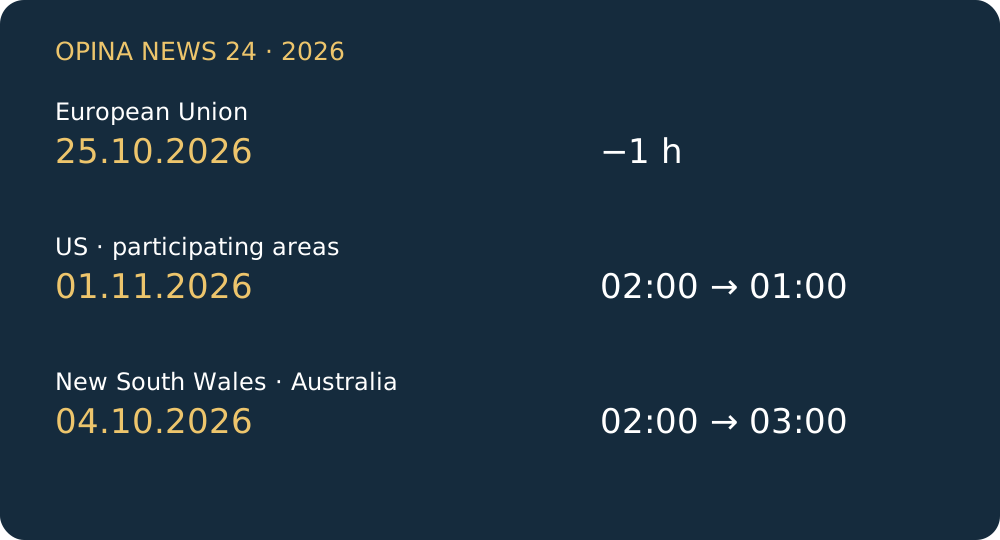
| European Union | 2026-10-25 | −1 h |
| United Kingdom | 2026-10-25 | 02:00 → 01:00 |
| US · participating areas | 2026-11-01 | 02:00 → 01:00 |
| New South Wales · Australia | 2026-10-04 | 02:00 → 03:00 |
EU · UK · USA · NIST · NSW · Australia
Spain: practical information
At 03:00 clocks return to 02:00. In the Canary Islands, 02:00 becomes 01:00. The day lasts 25 hours, with the affected hour occurring twice.
Check that automatic date, time and time-zone settings are enabled on your phone. Adjust manual clocks, alarm clocks and devices that do not update automatically.
If travelling or working overnight, check local times and your operator’s or employer’s instructions to avoid confusion over the repeated hour.
This information applies to Spain. Other countries may change clocks on different dates or not at all. A published calendar ending in 2026 does not by itself abolish seasonal clock changes.